
Your Cat Is Bored — And a DIY Cat Puzzle Feeder Can Fix That
A DIY cat puzzle feeder is a homemade toy that makes your cat work for their food — and you can build one in minutes using things you already have at home.
Here’s a quick overview of how to make one:
- Rolling Bottle Feeder – Poke kibble-sized holes in a plastic bottle, add food, let your cat roll it
- Egg Carton Feeder – Fill compartments with treats, cover some with lightweight objects
- Toilet Paper Roll Pyramid – Glue rolls into a pyramid on cardboard, hide kibble inside
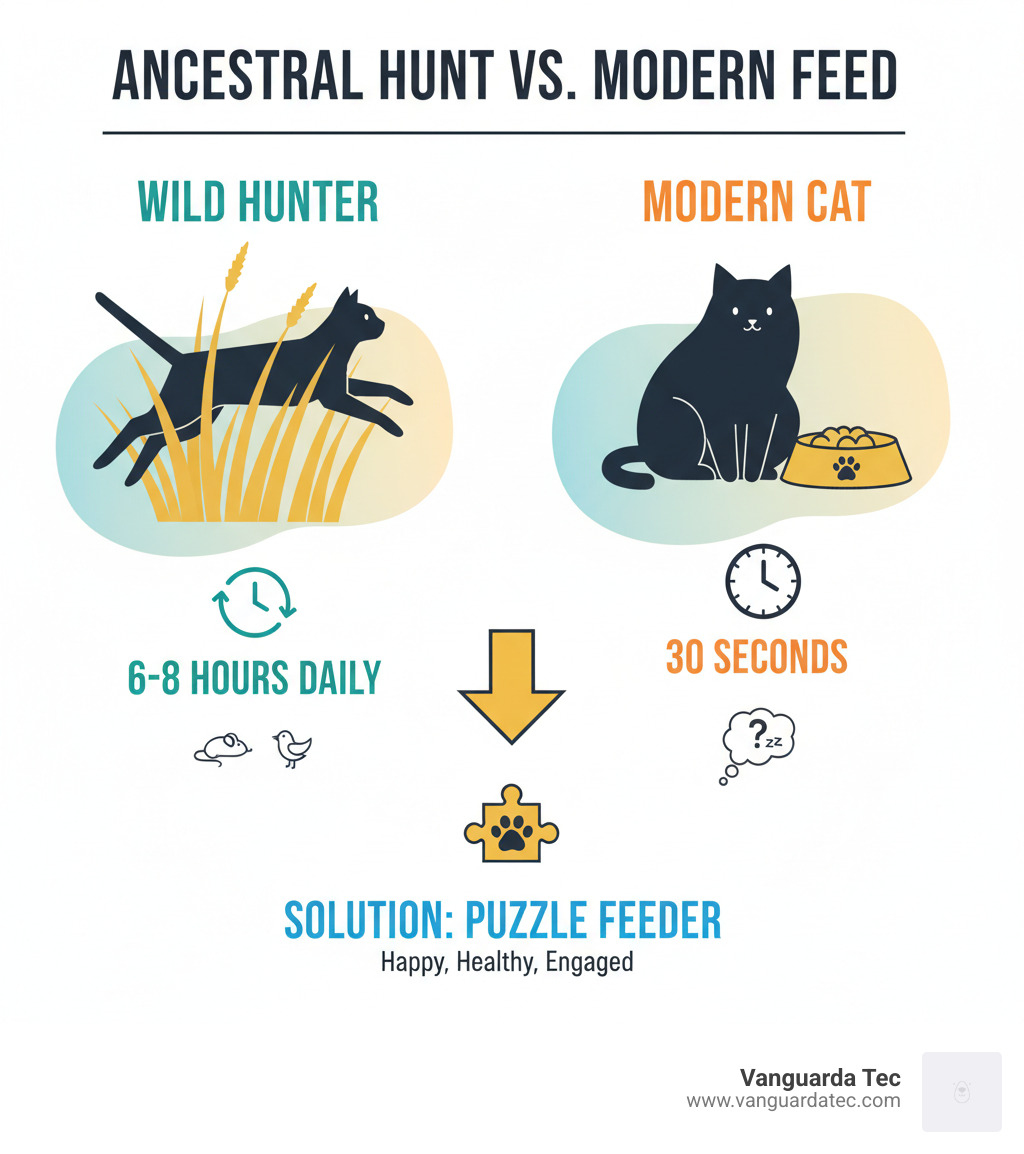
Here’s the problem most indoor cat owners don’t think about: your cat’s ancestors spent 6 to 8 hours a day hunting for food. Your cat? They finish their bowl in about 30 seconds — then stare at the wall for the rest of the day.
That gap between what cats were built to do and what modern life gives them is the root of a lot of frustrating behaviors. Scratching furniture. Overeating. Restlessness. Anxiety. It’s not bad behavior — it’s a bored brain with nowhere to go.
The good news: you don’t need to spend money on expensive toys or a fancy cat tree that never gets used. A simple homemade puzzle feeder can tap into your cat’s natural hunting instincts, slow down their eating, and give their brain the workout it’s been craving.
Research published in the Journal of Feline Medicine and Surgery confirms that puzzle feeders benefit cats of all ages — including seniors, kittens, and cats with health issues. And the best part? You can make one right now from your recycling bin.
Why Your Cat Needs a DIY cat puzzle feeder
The transition from wild predator to indoor companion has left many cats with a surplus of mental energy. In the wild, a cat’s day is defined by the “seeking system”—a neurological circuit that releases dopamine when an animal is looking for food. When we place a bowl of kibble on the floor, we bypass that entire rewarding process.
By introducing a DIY cat puzzle feeder, we are essentially restoring the “hunt.” This isn’t just about entertainment; it is about biological fulfillment. Studies show that cats using these feeders display significantly reduced aggression toward humans and other pets. They also engage in less destructive scratching because their brain is occupied with a constructive task.
The Science of Slower Eating
Many cats suffer from “scarf and barf”—the habit of inhaling dry food so quickly that they immediately regurgitate it. A puzzle feeder acts as a natural speed bump. Instead of a 30-second feeding frenzy, a meal might take 10 to 15 minutes of batting, pawing, and problem-solving. This natural portion control is a game-changer for weight management.
| Feature | Standard Bowl Feeding | Puzzle Feeder Feeding |
|---|---|---|
| Time to Finish | 30 – 90 seconds | 5 – 15 minutes |
| Mental Effort | Zero | High (Problem Solving) |
| Calorie Burn | Negligible | Active Foraging |
| Stress Levels | Can lead to boredom/anxiety | Lowers cortisol; releases endorphins |
| Digestion | Higher risk of vomiting | Improved due to slower pace |
Beyond physical health, these toys are vital for cognitive longevity. Just as humans do crosswords to keep their minds sharp, cats need puzzles to maintain their problem-solving abilities. If you want to dive deeper into the basics of making puzzle toys for pets at home, you’ll find that the principles of enrichment apply to almost any domestic animal.
Essential Materials for Homemade Cat Enrichment
One of the biggest myths in pet care is that enrichment has to be expensive. At Vanguarda Tec, we believe the best toys are often the ones you “upcycle” from your weekly recycling. Before you toss that egg carton or empty water bottle, consider it a potential piece of high-end feline engineering.

When making cat toys from household items, safety is the priority. Here is a list of common materials you’ll need:
- Cardboard: Shoe boxes, shipping boxes, and wine cases make excellent bases for stationary puzzles.
- Paper Tubes: Toilet paper and paper towel rolls are the “LEGO blocks” of the DIY cat world.
- Plastic Containers: Empty water bottles, yogurt cups, and margarine tubs (clean and sanitized).
- Muffin Tins: A kitchen staple that doubles as an instant slow feeder.
- Adhesives: Use non-toxic, child-safe glue or a hot glue gun (ensure all glue is completely dry and “strings” are removed before giving it to the cat).
- Tools: A pair of sharp scissors or an X-ACTO knife (adult supervision required!) and some sandpaper.
Safety Tip: Always use BPA-free plastics and avoid anything that previously held harsh chemicals. If you are using plastic bottles, use sandpaper to smooth the edges of any holes you cut. This prevents your cat from getting a “plastic cut” on their tongue or paws.
Step-by-Step: 3 Beginner-Friendly Designs
If your cat has never used a puzzle before, you want to ensure they experience “early wins.” A puzzle that is too hard will lead to frustration and a cat that walks away. We recommend starting with high-value treats (like freeze-dried chicken or tuna flakes) mixed with their regular kibble to increase the “scent attraction.”
For more inspiration, check out our beginner-friendly pet toy DIY guide to see how simple these projects can be.
1. The Rolling Bottle DIY Cat Puzzle Feeder
This is the “entry-level” toy for most cats. It mimics the movement of prey and provides an immediate reward.
- Step 1: Take a clean, dry plastic water bottle and remove the plastic wrapper and the ring from the cap.
- Step 2: Use a utility knife to cut 3 to 5 holes around the center of the bottle. The holes should be slightly larger than the kibble you use.
- Step 3: Use sandpaper to smooth the edges of the holes.
- Step 4: Place a handful of dry food inside and screw the cap back on.
- Step 5: Place it on the floor and give it a small nudge to show your cat how the food falls out.
This is one of the most effective homemade treat-dispensing toys because it encourages physical movement across the room.
2. The Egg Carton DIY Cat Puzzle Feeder
This is a stationary puzzle, perfect for cats who prefer to “fish” for their food with their paws.
- Step 1: Take a standard cardboard egg carton and remove the lid.
- Step 2: Place a few pieces of kibble in each compartment.
- Step 3: To make it a DIY cat puzzle feeder that actually challenges them, place lightweight items like ping pong balls or crumpled bits of paper over the top of the food.
- Step 4: Your cat will have to bat the balls away or reach around them to hook the food out.
3. The Toilet Paper Roll Pyramid
This design adds a vertical element to the challenge, requiring your cat to use their dexterity to reach deep into the tubes.
- Step 1: Gather 6 to 10 toilet paper rolls.
- Step 2: Cut a square base out of a shipping box (about 20x20cm).
- Step 3: Glue the rolls together in a pyramid formation (three on the bottom, then two, then one).
- Step 4: Glue the entire pyramid to the cardboard base so it doesn’t tip over.
- Step 5: Drop treats into the open ends of the tubes.
For more variations on this theme, see our guide on DIY hide-and-seek toys for cats.
Advanced Strategies: Wet Food and Expert Cats
Once your cat has mastered the basics, they might start solving these puzzles in record time. This is when you introduce “Expert Mode.” Advanced puzzles often involve multi-level challenges or different textures.
Adapting for Wet Food
Many owners think puzzle feeders are only for dry kibble, but wet food users can join the fun too!
- The Muffin Tin Hack: Spread wet food into the cups of a muffin tin. Cover the cups with tennis balls or plastic lids. Your cat has to move the “obstruction” to lick the food.
- The Ice Cube Tray: This is a natural slow-feeder. Smear wet food into the small compartments of an ice cube tray. The narrow spaces force the cat to use their tongue and small “scooping” motions.
- Licking Mats: You can create a DIY version by using a clean, textured silicone pot holder or a plastic lid with ridges.
The “Activity Board”
For the truly gifted feline, we recommend a stationary board that combines multiple puzzles. You can reuse jars for pet games by gluing small, clean plastic jars (like spice jars) at different angles onto a large cardboard base. Mix in some PVC pipe couplings of varying widths and heights. This creates a “forest” of obstacles that the cat must navigate to find their meal.
Training and Troubleshooting Your Feeder
Not every cat takes to a DIY cat puzzle feeder immediately. If your cat is staring at you with judgment instead of interacting with the toy, don’t worry—they just need a little “onboarding.”
Progressive Difficulty
The most common mistake is making the puzzle too hard on day one. If you are using a bottle feeder and the holes are too small, the cat will get frustrated and stop trying. Start with holes that are twice the size of the kibble so food falls out easily. As they get better, make a new bottle with smaller holes.
Monitoring for Frustration
Watch your cat’s body language. A little bit of pawing and focused staring is good—that’s the “seeking system” at work. However, if your cat starts biting the cardboard aggressively, growling, or walking away to meow at their empty bowl, the puzzle is too difficult. Simplify the task immediately to rebuild their confidence. Our complete guide to homemade pet toys offers more tips on matching toy complexity to your pet’s personality.
Hygiene and Safety
- Cleaning: Plastic feeders should be washed weekly with warm, soapy water. Cardboard feeders are “disposable”—once they get soggy or dirty, toss them in the recycling and build a new one. This also helps with variety!
- Supervision: Always supervise your cat the first few times they use a new design. Check for loose parts, sharp edges, or signs that your cat is trying to eat the cardboard rather than the food.
- Rotation: Cats are masters of efficiency. Once they “solve” a puzzle, it’s no longer a workout—it’s just a chore. Rotate your feeders every 2-3 days to keep the challenge fresh.
Frequently Asked Questions about DIY Cat Puzzle Feeders
What if my cat ignores the puzzle feeder?
This usually happens because the “reward” isn’t worth the “effort.” Try using a higher-value treat, like a small piece of tuna or a specialized cat treat, to prime the pump. Also, check the location. Place the feeder near their usual eating spot or in a “territory” they feel confident in, like near their favorite cat tower.
Can I use puzzle feeders for every meal?
Absolutely! In fact, many behaviorists recommend “binning the bowl” entirely. Transition slowly: start by putting 25% of their meal in a puzzle and 75% in the bowl. Over two weeks, shift the ratio until the bowl is gone. This provides consistent daily enrichment and helps with weight loss.
How often should I clean or replace DIY feeders?
Plastic items like bottles or yogurt containers should be sanitized weekly. Cardboard items like egg cartons or toilet paper rolls should be replaced whenever they show signs of wear, moisture, or bacterial buildup. Generally, a cardboard DIY cat puzzle feeder lasts about a week of heavy use.
Conclusion
At Vanguarda Tec, we believe that a happy cat is an active cat. You don’t need a massive budget to provide world-class enrichment for your feline friend. By repurposing household items into a DIY cat puzzle feeder, you are giving your cat more than just a snack—you are giving them a sense of purpose, a physical workout, and a calmer mind.
Whether it’s a simple rolling bottle or a complex multi-level activity board, the time you spend crafting these toys will pay off in a healthier, more engaged companion. Ready to build your next project? Start your DIY journey today and discover how easy it is to transform your home into a feline paradise.
