
Why Cats Need Homemade Toys (And How to Make Them Right Now)
If you’re looking for how to make homemade toys for cats, here’s a quick overview of the easiest options:
- Toilet paper roll puzzle – Fold the ends closed, poke small holes in the sides, and fill with treats.
- Sock fish – Stuff an old sock with catnip and scrap fabric, then tie it closed.
- Feather wand – Tie a string to a wooden dowel and attach feathers to the free end.
- Fleece fringe ball – Stack four small fleece squares, cut fringe on opposite edges, and tie a strip around the middle.
- Cardboard box condo – Stack boxes, cut doorways between them, and add peep holes.
Cats are natural hunters. Without an outlet for that instinct, indoor cats can get bored fast – and boredom often leads to scratching furniture, overeating, or other unwanted behaviors.
The good news? You don’t need to spend a lot of money to fix this.
Most cat toys you can make at home take less than 10 minutes and cost nothing. A crumpled ball of paper, an old sock, a cardboard box – cats often prefer these over expensive store-bought toys anyway.
The even better news: making toys yourself means you control the materials. No mystery plastics, no loose parts that could be swallowed, and no wasted money on something your cat ignores.
Why You Should Learn How to Make Homemade Toys for Cats
We all know the feeling: you spend $50 on a state-of-the-art, motion-activated laser gizmo, and your cat spends the entire afternoon playing with the box it came in. Cats are famously unimpressed by price tags. Learning how to make homemade toys for cats isn’t just a way to save a few dollars; it’s about understanding what actually makes your cat tick.
Enrichment is a vital part of feline health. When we provide DIY toys, we are offering mental stimulation that reduces stress and prevents boredom-induced behavioral issues like overgrooming or urinating outside the litter box. According to Indoor Cat Enrichment Ideas, satisfying a cat’s physical and emotional needs through play can significantly reduce anxiety.
Furthermore, DIY toys are incredibly cost-effective. As highlighted in 15 Easy DIY Cat Toys Your Cat Will Love – Pinterest, you can “spoil your favorite feline” without spending a lot of cash or needing expert craft skills. By repurposing household items, you’re not only being frugal but also sustainable.
Safety First: Avoiding Hazards in DIY Crafting
Before we dive into the “how-to,” we must address the “how-not-to.” A great DIY toy is a safe one. While we love the idea of using what we have, not every household item is cat-friendly.
For instance, Avoiding Choking Hazards in DIY Cat Toys emphasizes that small parts like beads, sequins, or loose googly eyes can be easily ripped off and swallowed. Here is a quick reference guide we’ve put together to help you vet your materials:
| Material | Safety Status | Precaution |
|---|---|---|
| Cardboard | Safe | Remove all staples and excess packing tape. |
| Fleece/Cotton | Safe | Use for “kickers” or stuffed toys; avoid fraying edges. |
| Yarn/String | Use with Caution | Only for interactive play; store away when not in use. |
| Wine Corks | Safe | Ensure they are natural cork, not plastic. |
| Pipe Cleaners | Supervised Only | Ensure sharp ends are tucked in; remove if chewed. |
| Rubber Bands | Hazardous | High risk of ingestion and intestinal blockage. |
| Feathers | Safe | Ensure they are securely attached to a wand. |
The golden rule of DIY play is supervision. Always inspect toys for wear and tear before each session. If a toy starts to fall apart, it’s time to toss it and make a new one—that’s the beauty of DIY!
Simple Projects: How to Make Homemade Toys for Cats Using Recyclables
You would be amazed at what usually ends up in your recycling bin that could actually be a cat’s favorite new possession. From Using Cardboard to Make Cat Playthings to turning old wine corks into feathered “prey,” the possibilities are endless.
- The Wine Cork Flutter: Take a natural wine cork and use a small nail to poke a hole in one end. Dip the ends of a few feathers in non-toxic glue and tuck them into the hole. Your cat will love the erratic way the cork bounces when batted.
- The Toilet Paper Roll Ring: Cut a toilet paper roll into 1-inch rings. Link them together or just toss them individually. They are light, easy to carry, and make a satisfying “skritch” sound on hardwood floors.
- The T-Shirt Knot: If you have an old, stained shirt, don’t throw it away! Check out Making Cat Toys from Household Items for ideas on braiding fabric strips into durable “snakes” for your cat to hunt.
Step-by-Step: How to Make Homemade Toys for Cats with Household Items
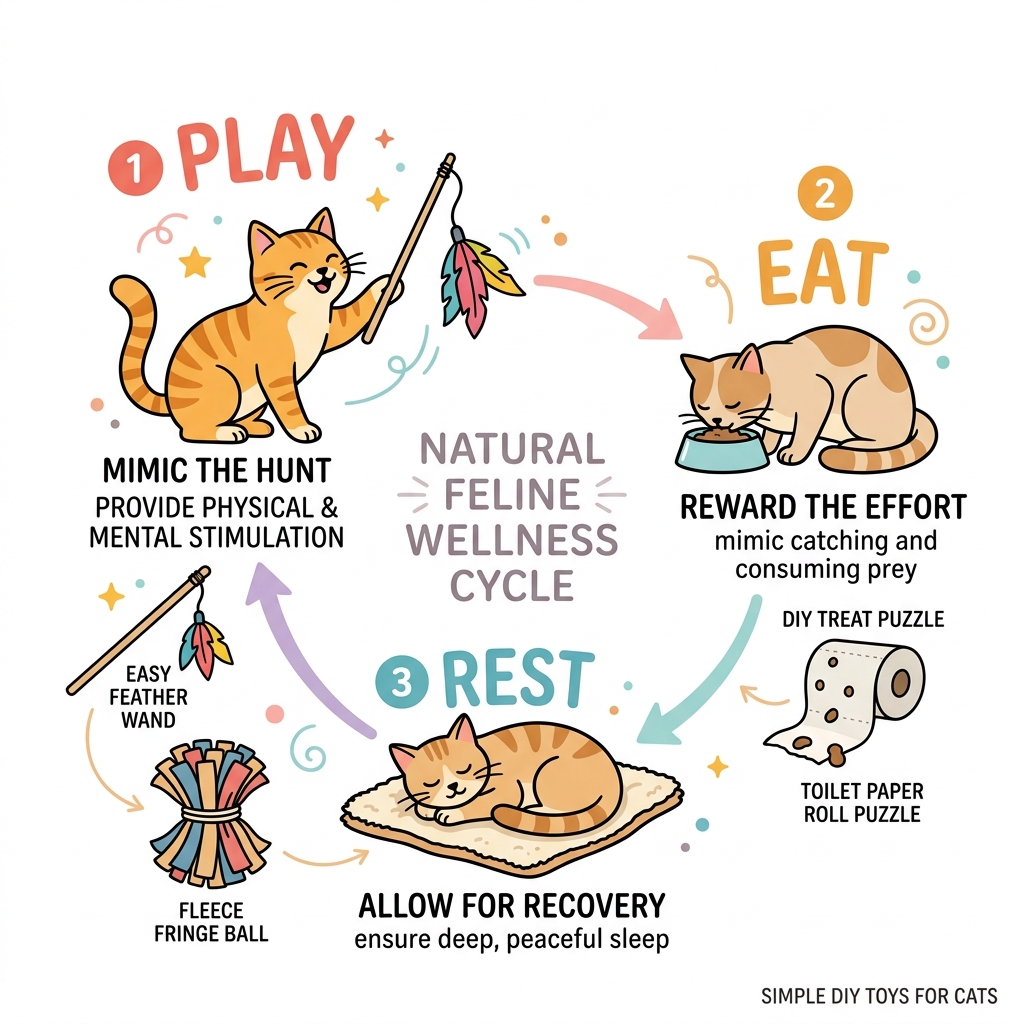
One of the best ways to keep a cat’s brain sharp is through foraging behavior. In the wild, cats spend a huge portion of their day searching for food. We can mimic this with a Cardboard Food Puzzle. This project takes about two minutes and provides hours of mental stimulation.
Materials Needed:
- One empty toilet paper or paper towel roll
- Scissors
- Your cat’s favorite dry treats or kibble
Instructions:
- Fold the Ends: Take your cardboard roll and fold the edges of both ends inward to create a sealed “pillow” shape.
- Cut Access Holes: Use your scissors to cut 3-4 small holes (about the size of a nickel) along the sides of the roll. Make sure the holes are slightly larger than the treats you’re using.
- Fill with Goodies: Open one end slightly, drop in a handful of treats, and seal it back up.
- The “Hunt”: Place it on the floor. Your cat will smell the treats and begin batting the roll around. As it rolls, treats will randomly fall out, rewarding their “hunting” efforts.
For more variations on this, see DIY Hide and Seek Toys for Cats.
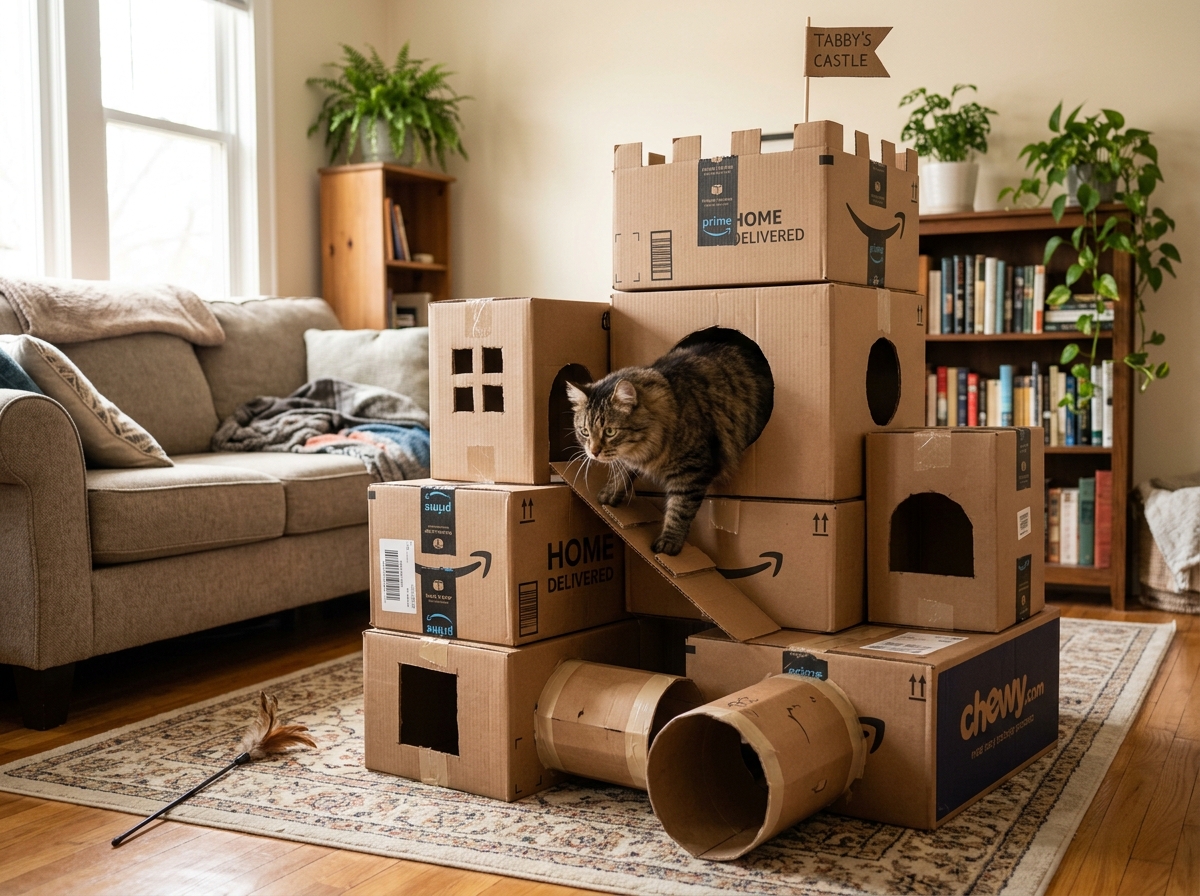
Building a Cardboard Box Cat Castle or Condo
If you really want to go all out, it’s time to build a fortress. Cats love vertical space and enclosed “hiding spots,” which is why a cardboard condo is the ultimate DIY project.
According to Cat Climbing and Playing Ideas, providing different levels for your cat to explore can help them feel more secure in their environment.
How to build it:
- Gather Boxes: Collect 3-4 sturdy shipping boxes of various sizes.
- Cut Doorways: On each box, cut a hole large enough for your cat to comfortably enter and exit.
- Add Peep Holes: Use a utility knife to cut smaller “windows” or peep holes. This allows your cat to play “peek-a-boo” and bat at passing toys from a safe distance.
- Stack and Secure: Stack the boxes. You might put a large box on the bottom and a smaller one on top. Secure them together using a non-toxic hot glue gun or heavy-duty packing tape (on the outside only).
- Interior Access: If you stack boxes vertically, cut a hole in the “ceiling” of the bottom box and the “floor” of the top box so your cat can climb between levels.
Interactive and Soft Toys: Yarn, Felt, and Fabric Options
While cardboard is great for solo play, interactive toys are where the real bonding happens. Using soft materials like fleece, felt, and old socks allows you to create “kickers” and “prey” that feel more realistic to a cat.
As seen on Homemade cat toys? : r/Frugal – Reddit, many owners find that a simple “sock fish” or a braided t-shirt rope provides more entertainment than any store-bought equivalent. These materials are also great for cats who like to “bunny kick”—the behavior where they hold a toy with their front paws and kick rapidly with their back legs. Check out Interactive Cat Toys a DIY Approach for more tips on designing toys that withstand this rough play.
Creating a Feather Wand for Interactive Play
A wand toy is the gold standard for cat exercise. It allows you to mimic the flight of a bird or the scurry of a mouse while keeping your hands safely away from sharp claws.
Materials:
- A wooden dowel (approx. 60cm long)
- Sturdy string, lycra cord, or 20lb test fishing line (approx. 1m long)
- Feathers, bells, or fabric scraps
- A drill (optional)
Steps:
- Prepare the Wand: If you have a drill, make a small hole an inch from the end of the dowel. If not, simply tie your string very tightly around the end, securing it with a drop of non-toxic glue if necessary.
- Attach the Line: Thread your string through the hole or secure your knots. For extra durability, we recommend tying the cord multiple times.
- Add the “Prey”: At the free end of the string, tie on your feathers and a small jingle bell.
- Pro Tip: Make the attachments interchangeable! Use a small swivel clip (the kind used for fishing) at the end of the string so you can swap out feathers for a felt “bug” or a yarn pom-pom to keep the “hunt” fresh.
For more detailed assembly steps, visit Feather Toys for Cats Easy DIY Steps.
How to Make Homemade Toys for Cats with Catnip Infusion
Did you know that 50-75% of cats have a genetic sensitivity to catnip? This is due to a compound called nepetalactone, which triggers a euphoric reaction lasting about 10 to 15 minutes. After this, cats usually become temporarily immune to its effects for an hour or two.
Making catnip-stuffed toys is a fantastic way to utilize this natural herb. Upcycled Sock Mice for Cats is a classic project for this.
The Sock Fish / Mouse:
- Take a small ankle sock (the “lone” ones whose partners the dryer ate are perfect for this!).
- Fill the toe section with 2 tablespoons of dried organic catnip mixed with some fabric scraps or polyester fiberfill.
- Tie a knot in the sock to seal the stuffing in the toe.
- If you’re feeling crafty, sew on two small felt ears or a felt tail. Avoid using buttons or beads for eyes, as these are choking hazards.
Community discussions on What are easy and simple ideas for making toys for cats? – Facebook suggest that even just “marinating” existing soft toys in a sealed container with loose catnip can refresh their appeal.
Maintenance and Playtime Best Practices
Once you’ve mastered how to make homemade toys for cats, you need to know how to keep them effective. Novelty is the key to a cat’s heart. If a toy is left on the floor 24/7, it becomes “dead prey” and the cat will eventually lose interest.
- Toy Rotation: Keep only 2-3 DIY toys out at a time. Store the rest in a “toy box” (or a sealed jar with catnip!). Every few days, swap them out. This makes the “old” toys feel brand new again.
- Cleaning: Fabric toys like those mentioned in Upcycling Socks into Cat Toys will eventually get covered in “cat spit” and dust. Most can be hand-washed with a mild, scent-free detergent and air-dried.
- The “Win”: Always end a play session by letting your cat catch the toy. This provides a sense of accomplishment and closes the “predatory loop.” Following a play session with a small treat or a meal mimics the natural “Hunt, Catch, Kill, Eat, Groom, Sleep” cycle.
- Inspection: Regularly check your wands and strings. If a string is fraying, replace it immediately to prevent your cat from swallowing fibers.
Frequently Asked Questions about DIY Cat Toys
Are homemade toys as safe as store-bought ones?
Yes, and sometimes they are even safer because you have total quality control! However, they require the same level of common sense. Avoid small, swallowable parts and always supervise play with string-based toys. A well-made DIY toy from safe materials like fleece or cardboard is perfectly safe for your feline friend.
How do I get my cat interested in a new DIY toy?
Remember: the toy is just an object until you bring it to life. Don’t just toss a feather wand on the floor and expect a reaction. Move it like a bird—short, fluttering movements followed by a “landing” behind a chair. Drag a felt mouse slowly across the floor, then make it “scurry” away when the cat notices. You have to act like the prey to spark their hunting instinct.
Can I use hot glue when making cat toys?
Standard craft-store hot glue is generally considered non-toxic once it has fully cooled and hardened. However, the danger isn’t toxicity—it’s ingestion. If your cat is a “chewer” who likes to eat plastic or cardboard, avoid using glue on parts they can reach. For structural items like cardboard condos, glue is usually fine as long as it’s not exposed.
Conclusion
At Vanguarda Tec, we believe that the best way to care for your pet is through personalized, hands-on engagement. Learning how to make homemade toys for cats isn’t just a fun weekend craft; it’s an investment in your cat’s mental and physical health. By using household items, you can create a rotating gallery of entertainment that keeps your cat’s hunting instincts sharp and their spirit happy.
Whether you’re stacking boxes for a cardboard castle or sewing a catnip lime slice, the time you spend crafting is time spent bonding with your pet. For more inspiration on creating a fun environment for all your furry friends, check out A Complete Guide to Homemade Pet Toys. Happy crafting!
